Do you need a child car seat in Europe and the region?
13 August 2026
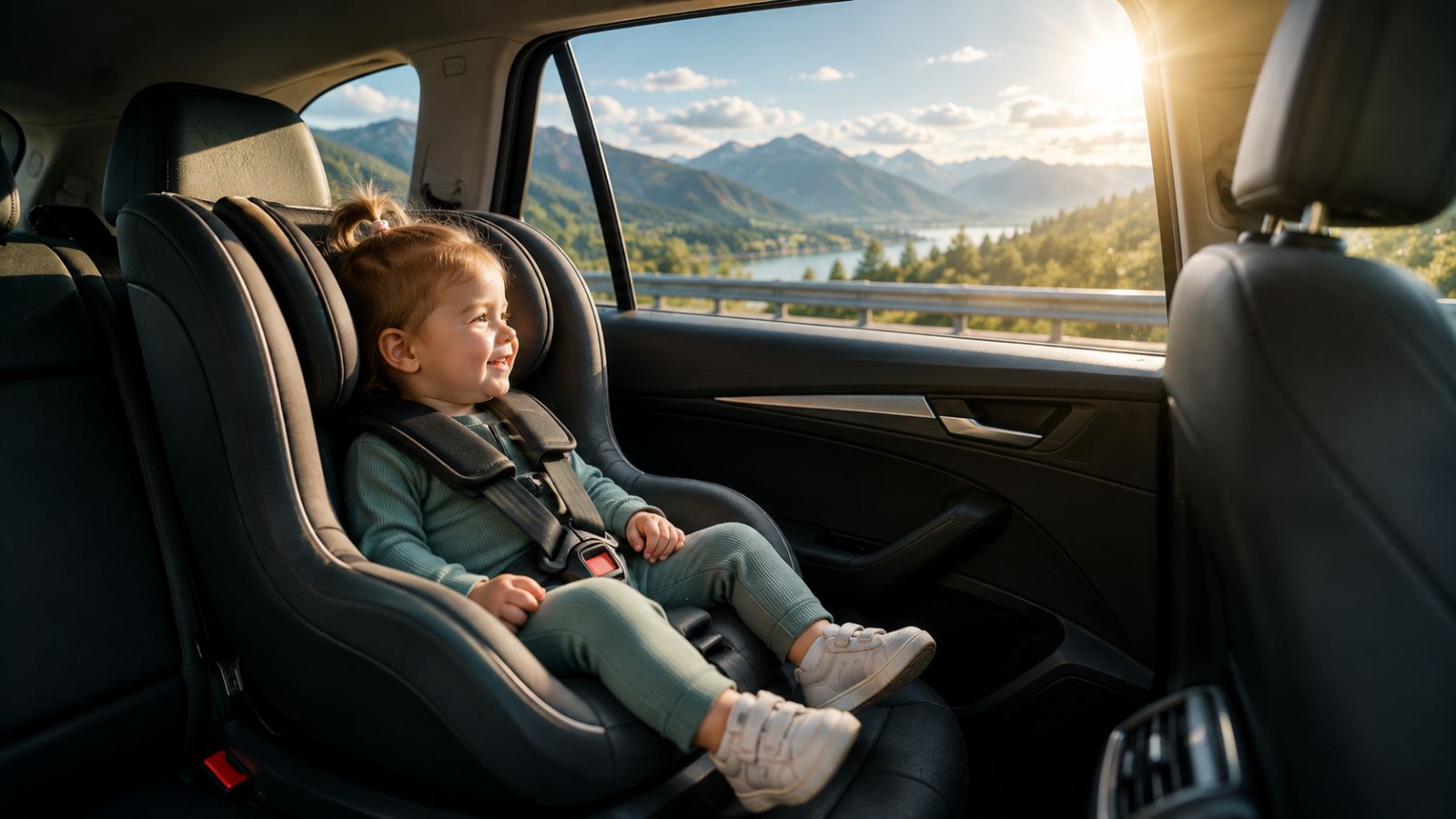
When you are getting ready for a trip with a child, whether it is a long weekend in a neighbouring country or a long summer holiday on the EU coast, the packing list is enormous. One item on that list, however, is not optional and not a matter of personal choice: the child car seat.
In Europe the rules are clear, strict and designed with one goal – protecting the youngest passengers.
To answer the question in the title right away: YES, by law you must have a child car seat throughout Europe and the region.
Below is a guide to help you understand the laws, the European standards and the safety rules.
What the law says: Height matters more than age
Laws across Europe are aligned with EU directives, and the main criterion for when a child can stop using a car seat (or booster) is no longer age alone, but the child's height. Seat belts in cars are designed for adults and cannot properly protect passengers shorter than 150 cm.
European Union (Germany, Austria, Italy, Croatia, Slovenia...): The law strictly requires a child to use an appropriate car seat or booster until they reach a height of 150 cm (or 12 years of age).
Countries of the region (Serbia, BiH, Montenegro, North Macedonia): The laws vary, but the lower threshold is most often 135 cm (with an age limit of up to 12 years), while a booster is recommended for children above that height up to 150 cm.
Advice for travellers: If you are driving from the region towards the EU, always follow the stricter rule (150 cm), because local police in Austria or Germany will not accept excuses about the laws in your home country.
European standards: What does "i-Size" mean?
When you buy a seat, you will find an orange label on it with the European certification. There are two valid standards in Europe:
The older standard (ECE R44/04): Divides seats by the child's weight (Groups 0, I, II, III). Although these seats have no longer been manufactured in the EU since September 2024, they remain completely legal to use if you already own one.
The new standard (ECE R129, or "i-Size"): Divides seats by the child's height. This standard is stricter because it requires mandatory side-impact testing and extends the requirement to travel rear-facing.
The golden safety rules across Europe
Rear-facing is the safest: Under the new EU (i-Size) standard, children must travel rear-facing until at least 15 months of age. All safety agencies nevertheless recommend that children stay in this position for as long as possible (ideally until the age of 4), because it drastically reduces the risk of fatal neck and spine injuries in a frontal collision.
The front-seat rule: Carrying a child in an infant carrier (facing backwards) on the front passenger seat is allowed in most European countries, but ONLY if the airbag is switched off. An airbag deploying in a crash is fatal for a baby. Older children (under 150 cm) should as a rule sit in the back.
Boosters with a backrest: European regulation is increasingly phasing out plain booster cushions. For children shorter than 125 cm, a booster with a backrest is mandatory, because a plain cushion offers absolutely no protection in a side impact.
Winter coats and harnesses: Never strap a child into a seat wearing a thick winter coat. In a crash the coat compresses, the harness goes slack and the child can be thrown out of the seat. The harness must be tight enough that you cannot pinch any material between the child's collarbone and the strap.
The most common myths about travelling with children
Myth: "I'll hold him on my lap, I'm stronger than the impact." At a speed of just 50 km/h, at the moment of impact a child's body becomes 30 to 60 times heavier. Physics is merciless – it is impossible to hold on to a child on your lap.
Myth: "We're driving slowly, just to the shop." EU statistics show that the largest number of accidents with serious consequences for children happen precisely on short trips in town, at speeds below 60 km/h.
Conclusion
European child car seat laws are not there to make travelling harder, but to make sure every passenger reaches their destination safely. Before you set off, check that the seat is fitted correctly and that it matches your child's height. It is an investment that cannot be measured in money.
Have a safe trip!